Exploring the Reggio Emilia Approach to Art Curriculum in Preschool Classrooms
- Ngoc Bao
- May 4
- 7 min read

Arts has a significant role in early childhood education as it offers children with various opportunities to explore the nature of knowing through the use of imagery, symbols and metaphors (Dinham & Chalk, 2022). Through arts, children express ideas, communicate emotions and construct meanings. For preschoolers aged between three to five, arts are not restricted to only drawing and painting. They include a wide range of multimodal media such as three dimensional constructions, drama, music and movements, digital media, and symbolic representation (Dinham & Chalk, 2022). These experiences support the development of self-identity, senses, social-emotional skills, which makes the arts a powerful tool for holistic learning.

Reggio Emilia approach provides an essential framework for arts learning as it positions children as capable, curious, and expressive learners who communicate through “a hundred languages.” This blog explores the arts curriculum for preschoolers through the Reggio Emilia approach, analysing key strategies for teaching, assessment, planning, and reflection, and offering a critique of the approach’s position on play. A research‑based example is included to illustrate how arts‑based inquiry unfolds in practice.
What about Reggio Emilia approach?
The Reggio Emilia approach originated in the town of Reggio Emilia, Italy, after World War II (Arthur et al., 2024). It positions children as sophisticated thinkers and communicators as well as capable learners who construct knowledge through relationships, exploration and expression. Unlike traditional art lessons that focus on techniques or finished products, this approach values the process of creation and the child’s voices. Key principles include:
The Hundred Languages: a metaphor used by Loris Malaguzzi to describe the ways in which children access materials and resources to investigate, test and propose new understandings about the world around them. Therefore, children express ideas through drawing, scuplture, movements, music, drama and digital media (Dinham & Chalk, 2022).
Environment as the third teacher: Learning environments are set up with intentionality to provoke children's interactions and inspire creativity as well as curiosity. Natural materials are widely used due to its beauty and children's fascination with them (Mages, 2016)
Pedagogical documentation: Children's artworks, transcripts and photographs can be used to make their learning visible and provide children with opportunities to revisit their learning projects or experiences (Richards, 2014).
Collaboration: The educators inspired by Reggio Emilia actively plan for strategies that support children's participation and collaboration. Children develop relationships with peers as children move through their own and others' zone of proximal development (Harcourt, 2015).
These principles position the arts not as a subject but as a central mode of thinking, communicating and researching
Teaching strategies in Reggio Emilia Arts Education
1. Provocations and Invitations to create
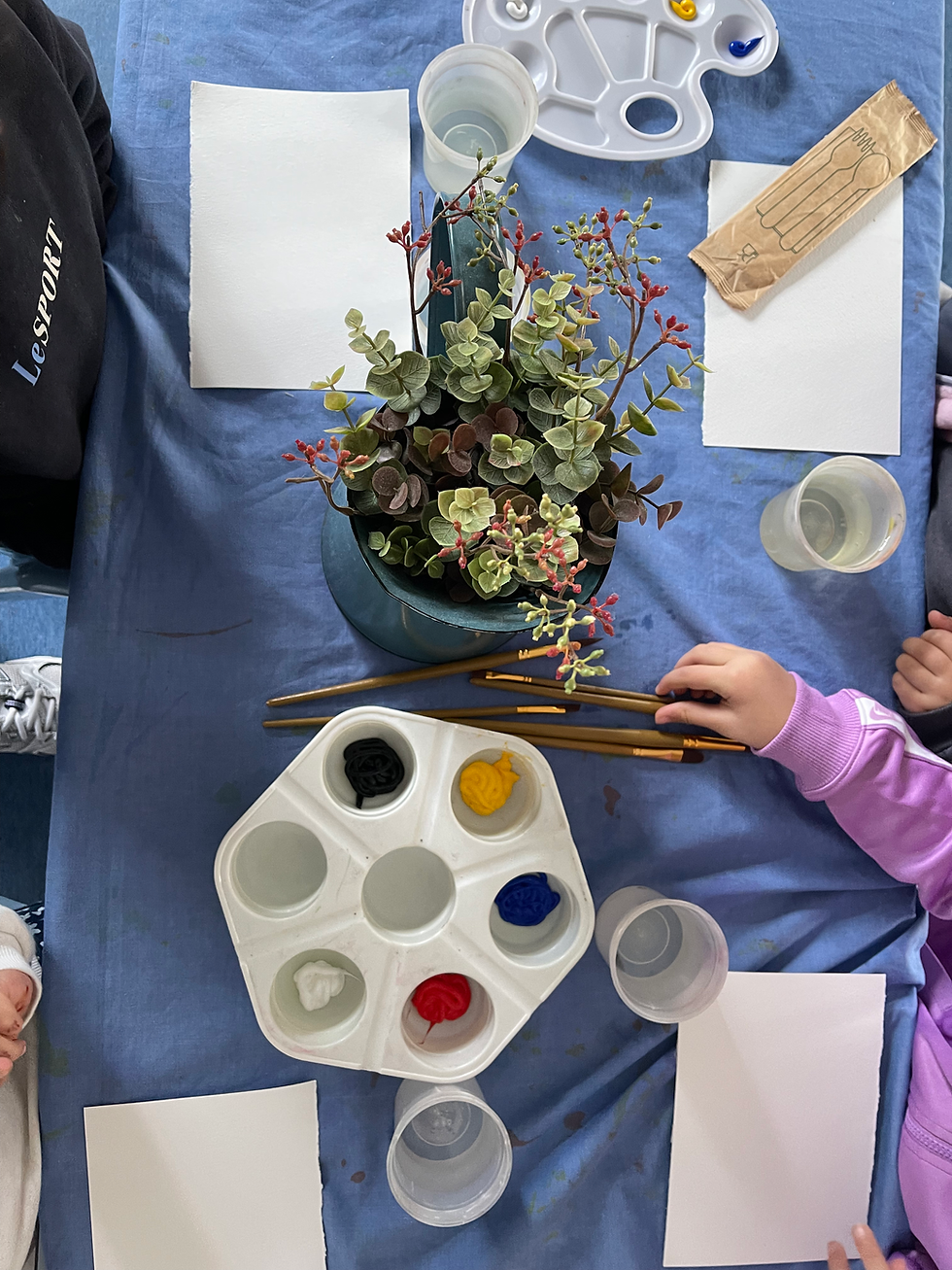
Educators design and set up provocations - intentional placements of materials that invite exploration (Mages, 2016). For examples, natural lights, pebbles, lead pencils and large sheets of paper can be arranged in a way that provoke children's curiosity about shadows, distances and how different angles of light will influence the size of shadows. These provocations provoke inquiry and encourage children to explore different ways to manipulate materials and different possibilities without rigid outcomes.
2. Open‑Ended Materials

Reggio Emilia arts education utilises a wide range of open‑ended materials such as clay, wire, fabric, loose parts, natural objects, and digital tools. These materials allow children to manipulate, transform, and combine elements in creative ways. Open‑ended materials support divergent thinking and encourage children to express complex ideas (Dinham & Chalk, 2022).
3. Co‑Researching and Co‑Constructing Knowledge
Educators act as co‑researchers, engaging alongside children in artistic inquiry. They ask open‑ended questions such as “What do you notice about the shadows?” or “How could we make this sculpture stronger?” This approach positions children as active participants in knowledge construction rather than passive recipients of instruction (ADGE, 2022). It also cultivate the rapport between teachers and the children with whom they interact (Mages, 2016).
4. Multimodal Expression
Reggio Emilia inspired art experiences allow children to use different media to convey their ideas. For example, a project about birds can include drawing birds from observations, constructing nests and birds' structures with clay, creating bird sounds with instruments and digital technologies, developing drama about birds' behaviours and photographs of local birds/ This integration of multimodal media deepens children's understanding and support diverse learning styles.
5. Emphasis on Process Over Product
Educators value the process of artistic exploration rather than the final artwork. Children are encouraged to revisit, revise, and refine their creations, fostering persistence and reflective thinking (Dinham & Chalk, 2022).
Assessment Strategies in Reggio Emilia Arts Education
1. Pedagogical Documentation
Documentation is the central of assessment in Reggio Emilia approach. It includes photographs of children’s learning processes, transcripts of conversations, children’s drawings and sculptures, educator reflections, and learning panels displayed in the environment. Through these types of documentation, children are provided with opportunities to think critically, hypothesise, and problem-solve in their learning, dispositions, and engagement (Arthur et al., 2024).

2. Analysis of Dialogue and Artistic Choices
Educators analyse children’s language, gestures, and material choices to understand their meaning‑making. For example, a child’s repeated use of spirals may indicate emerging symbolic thinking or emotional expression (Howard & Mayesky, 2022).
3. Portfolios and Learning Journals
Children’s artworks and documentation are compiled into portfolios that support educators in assessing children's development over time. These portfolios support assessment, planning, family engagement, and children’s self‑reflection (Arthur et al., 2023).
4. Collaborative Interpretation
Assessment is not done in isolation. Educators regularly communicate with colleagues, families and children to interpret documentation, identify emerging interests, and plan next steps. This collaborative approach strengthens the reliability and depth of assessment (ADGE, 2022)
Planning Strategies in Reggio Emilia Arts Education
1. Emergent Curriculum
Reggio Emilia Arts Education aligns with emergent curriculum as it evolves from children’s interests, questions, and artistic explorations. Educators observe children and use documentation to identify themes that can be used to extend children's learning (Queensland Curriculum and Assessment Authority [QCAA], 2014, p.1).
2. Project‑Based Learning
A project allows children develop ideas, investigate concepts of arts in depth, revisit their works and deepen their own understanding (Arthur et al., 2024). A project on light, for example, may include shadow drawing, experimenting with torches, creating sculptures that cast shadows, and exploring colour mixing on light tables. Projects can last weeks or months, allowing children to revisit ideas and develop stronger understanding (Helm & Katz, 2016: Robinson et al., 2018).
3. Integration Across Learning Areas
Arts planning is interdisciplinary. A project may integrate science (observing natural forms), literacy (storytelling through art), mathematics (patterns, symmetry, shapes), and social learning (collaborative murals). This holistic approach reflects how children naturally learn.
Reflection Strategies in Reggio Emilia Arts Education
Reflection is a process in which educators think critically about children's art-making processes, theories, challenges and future planning ideas (Gobby & Walker, 2022). Critical reflections ensure that educators are responsive to children's needs, learning dispostions. It also ensures that educators reflect on the dominant narratives, personal biases and assumptions, educational practices that potentially silence the voices of certain children (Gutek, 2014).
Critique the position of Reggio Emilia approach in play
Within Reggio Emilia approach, play and learning are interwoven. In the current era of emphasising on academic content in early childhood education (Campbell, 2015), arts provide children with opportunities to play, to ask questions, to wonder and to develop relationships with the environments, peers and teachers. This proposes several strengths:
Children's agency is valued, allowing them to choose materials and directions of their own play and learning. Through open-ended play, children choose materials, determine directions and negotiat ideas with peers. This fosters children's confidence, ownership and intrinsic motivation - qualities that are important for the development of artistic thinking (O' Donnell et al., 2019).
Play is considered an important mode of artistic inquiry. Through play, children develop hypotheses, manipulate materials, and express theories of their exploration using visual arts. This aligns with contemporary theories of children's learning where play is the vehicle for meaning-making, symbolic representation and emotional expressions (AGDE, 2022).
Creativity and imagination are integrated across different learning areas. Instead of positioning arts as product-driven actitvities, Reggio Emilia approach positions imaginations as a cognitive tool that support exploration across domains.
The environment itself supports open-ended play through open-ended materials, aesthetic arrangements, and intentionally organsied spaces that provoke curiosity and exploration (Sonter & Jones, 2018).
Limitations: The emergent curriculum may lack explicit teaching of art techniques unless the educators possess high level of skills and confidence (Dinham & Chalk, 2022). While open-ended play encourage creativity and imagination, some children benefit from intentional modelling of techniques such as shading techniques, paint brushes control, colour theory, or develop structures for sculpture (Dinham & Chalk, 2022). Without scaffolding, children may not explore other forms of arts to advance their artistic expressiosna or rely on repetitive forms of expression. For example, educators suggest children to use watercolour alongside colored pencils to provide depthness in children's drawings.
In addition, some children will have better engagment with play in a consistent environment. While many children benefit from the freedom and flexibility offered in curriculum inspired by Reggio Emilia approach, others—particularly those who prefer predictability, structure, or clear expectations—may feel overwhelmed or disengaged when boundaries are not explicit. Neurodivergent children, for example, may require more intentional scaffolding, sensory supports, or visual structure to participate meaningfully in artistic play. Without these supports, the open‑ended nature of Reggio play may unintentionally privilege children who are already confident and familiar with exploratory learning approaches (Hancock & Carter, 2016).
Additionally, the perspective “play is learning” can sometimes restrict the need for educators to intentionally teach cultural, technical, or disciplinary knowledge. Artistic traditions—such as weaving, music, or storytelling—carry cultural knowledge and values that may not emerge spontaneously through play. If educators rely solely on emergent exploration, children may miss opportunities to engage with diverse artistic heritages or develop foundational skills that support later learning. This reinforces the need for a balanced pedagogy that honours children’s agency while recognising the value of guided, culturally responsive curriculum.
References
Arthur, L., Beecher, B., Death, E., Dockett, S., & Farmer, S. (2024). Programming and planning in early childhood settings. (9th ed.). Cengage Learning Australia
Australian Government Department of Education. (2022). Belonging, Being and Becoming: The Early Years Learning Framework for Australia (V2.0). Australian Government Department of Education for the Ministerial Council. https://www.acecqa.gov.au/sites/default/files/2023-01/EYLF-2022-V2.0.pdf.
Dinham, J., & Chalk, B. (2022). It’s arts play: young children belonging, being & becoming through the arts (2nd ed.). Oxford University Press.
Gobby, B., & Walker, R. (2022). Powers of curriculum: sociological aspects of education (2nd ed.). Melbourne: Oxford University Press Australia and New Zealand.
Hancock, C. L., & Carter, D. R. (2016). Building environments that encourage positive behaviour: The preschool behaviour support self-assessment. YC: Young Children, 71(1), 66-73.
Mages, W. K. (2016). Taking inspiration from Reggio Emilia: An analysis of a professional development workshop on fostering authentic art in the early childhood classroom. Journal of Early Childhood Teacher Education, 37(2), 175–185. https://doi.org/10.1080/10901027.2016.1165763
O’Donnell, A., Dobozy, E., Barlette, B., Nagel, M., Smala, S., Wormal, C., Yates, G., Spooner-Lane, R., Youssef-Shahala, A., Reeve, J., & Smith, J. (2019). Educational Psychology (3rd Australian ed.). John Wiley & Sons.
Richards, R. (2014). The private and public worlds of children's spontaneous art. Studies in Art Education, 55(2), 143-156.
Sonter, L. J., & Jones, D. J. (2018). Drawing a tool to support children’s executive function in play. International Art in Early Childhood Research Journal, 1(1), 1-14. https://www.artinearlychildhood.org/content/uploads/2022/03/ARTEC_2018_Research_Journal_1_Article_6_Sonter.pdf.
Comments